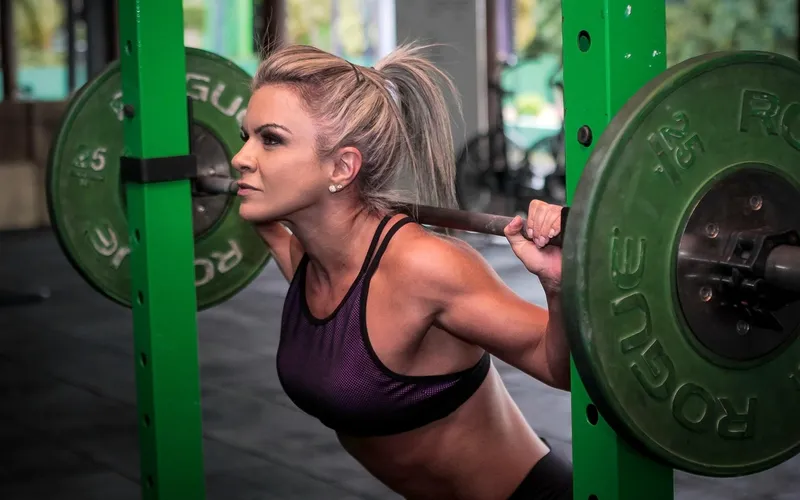
A 3-day full body program trains every major muscle in each session, three times a week with a rest day between. It meets the guideline of training all major muscle groups at least twice a week with room to spare, and it is the usual choice for 3 days because each muscle gets hit three times. Any level can use it; experience changes the exercises and the loads.
On this page
What it is
In a full body program every session trains the legs, the chest, the back, the shoulders and a little arm work. You do it three times a week, usually on non-consecutive days such as Monday, Wednesday and Friday. The sessions are three different days rather than the same one repeated: the main movement patterns stay, and the exercises rotate.
The case for it is simple. Guidelines ask for all major muscle groups to be trained at least twice a week 1, and a meta-analysis found that training each muscle group twice a week gave more muscle growth than once 2. Three days gives each muscle three chances, in sessions that stay short because no day carries a whole body part's worth of sets.
Who it suits
Everyone with three days, whatever their level. Experience changes what goes inside the sessions: a first-timer chooses a leg press, a goblet squat and machines, and an experienced lifter keeps the barbell back squat and heavier loads. It is also kind to a messy week. If a Wednesday disappears, you still have trained the whole body on Monday.
If you have 6 days and like long sessions, push pull legs trains each muscle twice with more volume in each visit. With four, see the upper lower split.
A sample week
Three different days, A, B and C. Each starts with a short warm-up of a few light sets of the first lift. Sets are working sets.
| Day | Exercise | Sets x reps | Rest |
|---|---|---|---|
| A | Leg press | 3 x 8 to 10 | 2 min |
| A | Dumbbell bench press | 3 x 8 to 10 | 2 min |
| A | Seated cable row | 3 x 8 to 10 | 2 min |
| A | Dumbbell lateral raise | 2 x 12 to 15 | 60 sec |
| A | Plank | 2 x 30 to 45 sec | 60 sec |
| B | Dumbbell shoulder press | 3 x 8 to 10 | 2 min |
| B | Romanian deadlift | 3 x 8 to 10 | 2 min |
| B | Wide-grip lat pulldown | 3 x 8 to 10 | 2 min |
| B | Leg extension | 2 x 10 to 12 | 90 sec |
| B | Triceps pushdown | 2 x 10 to 12 | 60 sec |
| C | Goblet squat | 3 x 8 to 10 | 2 min |
| C | Push-up or incline push-up | 3 x 8 to 12 | 90 sec |
| C | Bent-over dumbbell row | 3 x 8 to 10 | 2 min |
| C | Lying leg curl | 3 x 10 to 12 | 90 sec |
| C | Dumbbell biceps curl | 2 x 10 to 12 | 60 sec |
Run it A, B, C and keep going in that order. If you miss one, skip it and take the next session in the order. Do not double up. A common arrangement is to put the lower body first on one day and the upper body first on the next, so neither half always trains when you are tired. If a session has less time, cut the last one or two exercises, not the first.
Sets, reps and rest
In this sample each large muscle gets roughly 6 to 9 hard sets across the week, a little under the around 10 weekly sets per muscle group that guidelines mention for muscle growth 1. Add a set to a lift or two where you have time. More sets help on average, but each extra one adds less than the one before 3, which is why you do not need to chase high numbers. The research page on weekly sets explains the curve.
Rep ranges of 8 to 12 are easy to learn on and leave room to progress. A review of 21 studies found that light and heavy loads, each taken to failure, built similar muscle size, while heavy loads gave bigger gains in one-rep max strength 4. So a range of loads works; see light versus heavy loads.
For rest, a review found that 60 to 120 seconds seemed enough for untrained people, and that trained people seemed to need more than 2 minutes to maximise strength 5. Use the long end for the big lifts and a minute for small ones. More at rest between sets.
You do not need to reach failure. In a meta-analysis, sets stopped short of failure gave similar muscle growth when volume was similar 6, so finish most sets with 2 to 3 reps in reserve. See training to failure.
Eight weeks of progression
Run the A, B, C sessions in order for eight weeks. What changes is the number of sets and how close to the limit you go. Stopping 2 to 3 reps short of failure gave similar muscle growth in a meta-analysis when volume was similar 6.
| Week | Sets per main exercise | How hard | Notes |
|---|---|---|---|
| 1 | 2 | 4 reps left at the end of the last set | Learn the movements, find the machine settings |
| 2 | 3 | 3 reps left | Add weight where you hit the top of the range |
| 3 | 3 | 3 reps left | Same exercises, small weight steps |
| 4 | 3 | 2 to 3 reps left | Weights should feel like work now |
| 5 | 3 | 2 to 3 reps left | Add a set to one or two lifts if you have time |
| 6 | 3 | 2 reps left | Keep the form the same as week 1 |
| 7 | 3 | 2 reps left | The hardest week of the block |
| 8 (easier) | 2 | 4 reps left | About a third fewer sets, then restart at week 2 with heavier weights |
How to adjust it:
- Miss a session: skip it and take the next in the order. Do not double up.
- Missed two weeks or more: restart at week 2 with lighter weights.
- Short on time: drop the last one or two exercises of the day, not the first.
- A lift stalls: keep going for a couple of sessions, then take an easier week.
Progression
Use double progression: work within a rep range, add a rep each session, and when every set reaches the top, add the smallest weight step and drop back to the bottom of the range. A newer lifter often gets there quickly and adds weight every week or two; a trained lifter may take a month. Weight steps are small: 2.5 kg on a barbell, small steps on dumbbells and cable stacks. If a lift stalls, keep going for a couple of sessions first. If your reps fall for two or three sessions in a row, or you feel run down, take an easier week with about a third fewer sets. A fixed schedule is not needed for most people.
Swaps for knees and backs
If your knees are sore, use the leg press and a glute bridge instead of squats and lunges, or stay in a smaller range. The guides on knee-friendly leg exercises and training with knee pain cover the options.
If your lower back is sore, swap the Romanian deadlift for a lying leg curl and keep the supported rows and pulldowns. A dead bug or bird dog is a gentle core option. See exercises for lower back pain and training with back pain. Pain that persists is one for a doctor or physiotherapist.
Fitting it to your days
Three non-consecutive days is the classic pattern, but it is not a rule. Tuesday, Thursday and Saturday work. The one thing to avoid is stacking all three days together with nothing between. If you can only train twice some weeks, take the two best days and let the third be a bonus; the 2-day full body program is the same idea with less. See also how many days a week to lift and how to stick with training.
How Amble does it
Amble defaults to full body for 3 lifting days, with three different full body days, but it does not lock you in. It writes your program case by case, in any weekly layout, from the days, the minutes and the kit you have, and anyone can ask for push pull legs on 3 days instead. The coach proposes changes, for example an easier swap when a knee hurts, and nothing changes until you confirm.
Questions
Is 3 days of full body enough to build muscle?
Yes. Guidelines ask for all major muscle groups to be trained at least twice a week and put the volume for muscle growth at around 10 sets per muscle group a week 1. Three full body sessions reach that without long workouts.
Do I need to change the exercises every session?
No. Keep the same main lifts from week to week so you can see progress. A common approach is to alternate which half of the body goes first, and to swap one accessory between the A and B sessions so the week does not feel copied.
What if I train 3 days but not on a steady schedule?
A full body program copes with that better than most splits. Any three days with a rest day or two between work. If you miss one, skip it and take the next session in the order. Do not double up.
Sources
- American College of Sports Medicine. Resistance Training Prescription for Muscle Function, Hypertrophy, and Physical Performance in Healthy Adults: An Overview of Reviews. Medicine and Science in Sports and Exercise, 2026. acsm.org/resistance-training-guidelines-update-2026
- Schoenfeld BJ, Ogborn D, Krieger JW. Effects of Resistance Training Frequency on Measures of Muscle Hypertrophy: A Systematic Review and Meta-Analysis. Sports Medicine, 2016;46(11):1689-1697. doi:10.1007/s40279-016-0543-8 · PubMed
- Pelland JC, Remmert JF, Robinson ZP, Hinson SR, Zourdos MC. The Resistance Training Dose Response: Meta-Regressions Exploring the Effects of Weekly Volume and Frequency on Muscle Hypertrophy and Strength Gains. Sports Medicine, 2026;56(2):481-505. doi:10.1007/s40279-025-02344-w · PubMed
- Schoenfeld BJ, Grgic J, Ogborn D, Krieger JW. Strength and Hypertrophy Adaptations Between Low- vs. High-Load Resistance Training: A Systematic Review and Meta-analysis. Journal of Strength and Conditioning Research, 2017;31(12):3508-3523. doi:10.1519/JSC.0000000000002200 · PubMed
- Grgic J, Schoenfeld BJ, Skrepnik M, Davies TB, Mikulic P. Effects of Rest Interval Duration in Resistance Training on Measures of Muscular Strength: A Systematic Review. Sports Medicine, 2018;48(1):137-151. doi:10.1007/s40279-017-0788-x · PubMed
- Refalo MC, Helms ER, Trexler ET, Hamilton DL, Fyfe JJ. Influence of Resistance Training Proximity-to-Failure on Skeletal Muscle Hypertrophy: A Systematic Review with Meta-analysis. Sports Medicine, 2023;53(3):649-665. doi:10.1007/s40279-022-01784-y · PubMed