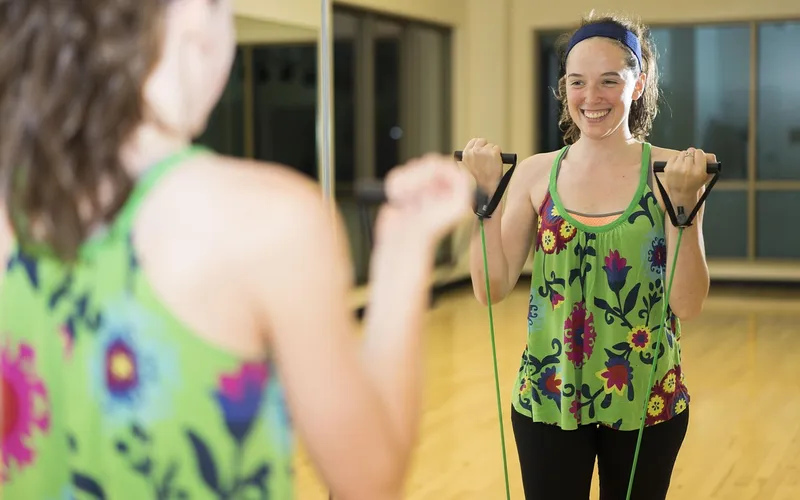
Eight band exercises cover the whole body: squat, pull-through, glute bridge, chest fly, pull-apart, shoulder press, monster walk and leg curl. Do 2 or 3 sets of 12 to 15, twice a week. Bands work well for adults starting out, and they progress by switching to a stronger band or shortening the band.
On this page
Do bands actually work?
They do. The American College of Sports Medicine's 2026 review of the evidence found that bands, bodyweight and home training give marked benefits for strength and muscle, and that machines versus free weights did not consistently change outcomes for average healthy adults 1.
Bands have a feel of their own. The tension rises as the band stretches, so an exercise is easiest at the bottom and hardest at the end. Many people with sore joints like that: the hardest point of the rep usually comes where the joint feels most stable.
The kit
Most people do well with three loop bands or tube bands in light, medium and heavy, plus a door anchor. Colours are not standard between brands, so test them yourself rather than trusting the label.
A good starting band lets you do 15 reps of a squat with the last few feeling like work. Your upper body will usually need a lighter band than your legs.
The workout
Work through it as a circuit: one set of each exercise in order, then go round again. Rest only as long as it takes to set up the next one, and take a two-minute break between rounds. Two rounds take about 20 minutes, three about 30.
| # | Exercise | Reps | What it trains |
|---|---|---|---|
| 1 | Banded squat | 12 to 15 | Thighs and hips |
| 2 | Band pull-apart | 15 | Upper back and rear shoulders |
| 3 | Band pull-through | 12 to 15 | Hamstrings and glutes |
| 4 | Standing band chest fly | 12 to 15 | Chest |
| 5 | Banded glute bridge | 15 | Glutes |
| 6 | Band shoulder press | 10 to 12 | Shoulders and triceps |
| 7 | Band monster walk | 10 steps each way | Outer hips |
| 8 | Seated band leg curl | 12 to 15 | Hamstrings |
Start the first week with two rounds. Add the third round in week two or three if you are recovering well between sessions.
The order alternates lower body and upper body, so one area rests while the other works. That is what makes a circuit time-efficient.
Getting the setup right
Squat. Stand on the band with feet hip-width apart and hold it at your shoulders. The tension pulls you down, so stand up firmly and lower with control.
Pull-through. Anchor the band low behind you, face away, hold it between your legs and hinge your hips back. Stand tall by squeezing your glutes, not by leaning back.
Chest fly. Anchor at chest height behind you and step forward until the band is taut with your arms out wide. Bring your hands together in front with a soft bend in the elbows.
Monster walk. Band above the knees or around the ankles, slight squat, step diagonally. Keep tension on the band the whole time so your feet never come together.
Making it harder
Bands do not come in kilos, so you need other ways to see progress:
- More reps. Go from 12 to 20 before changing anything else.
- Shorter band. Step wider on a squat band, or stand further from the anchor. Same band, more tension.
- Slower reps. Three seconds out, three seconds back.
- Stronger band. Move up one band and drop back to 12 reps.
- Two bands together. Useful for squats once you outgrow the heaviest band.
You do not need to go to complete failure on each set. Stopping a couple of reps short gave similar muscle growth in the research when the total amount of work was similar 2. With bands this matters, because form tends to fall apart before the muscle does.
Two exercises worth adding for shoulders
If your shoulders feel stiff or you spend the day at a desk, add 2 sets of 15 of the band external rotation at the end. The band lateral raise is a good extra for the side of the shoulders once the main circuit feels easy.
Bands pair well with a pair of dumbbells or with bodyweight work. The bodyweight workout for beginners and the dumbbell workout can share a week with this one, and strength training at home explains how to cover each movement over the week.
Sources
- American College of Sports Medicine. Resistance Training Prescription for Muscle Function, Hypertrophy, and Physical Performance in Healthy Adults: An Overview of Reviews. Medicine and Science in Sports and Exercise, 2026. acsm.org/resistance-training-guidelines-update-2026
- Refalo MC, Helms ER, Trexler ET, Hamilton DL, Fyfe JJ. Influence of Resistance Training Proximity-to-Failure on Skeletal Muscle Hypertrophy: A Systematic Review with Meta-analysis. Sports Medicine, 2023;53(3):649-665. doi:10.1007/s40279-022-01784-y · PubMed