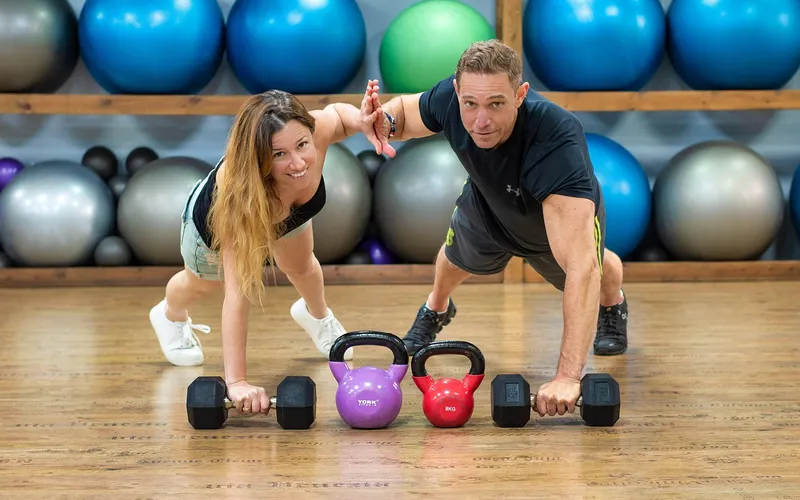
A 2-day full body program trains every major muscle on both days, with at least a day between. It meets the minimum in the guidelines, which ask for all major muscle groups to be trained on at least two days a week. It is a complete program for a busy week, and any level can use it.
On this page
What it is
Two sessions a week, each training the whole body: a leg movement, a push, a pull and a bit of core. Because each muscle is trained twice, it matches the minimum the guidelines set 1, and a meta-analysis found that training each muscle twice a week gave more muscle growth than once a week 2.
It is the program for the week you are busy, the person who is starting out, and anyone who prefers a quiet routine. It is also the floor of the system: if a three-day plan is out of reach, this is what you fall back to. See the 3-day full body program for the step up.
Who it suits
Everyone, and for different reasons. A first-timer learns the movements without soreness piling up. A busy parent or shift worker keeps a habit alive. A lifter in a heavy work month maintains. The program does not depend on level; what changes is exercise choice. A newer lifter uses the leg press, the machine chest press and the seated cable row. An experienced lifter uses the barbell back squat, the barbell bench press and the bent-over barbell row.
A sample week
Two different sessions, each with six exercises. Sets are working sets after a warm-up.
| Day | Exercise | Sets x reps | Rest |
|---|---|---|---|
| A | Leg press | 3 x 8 to 10 | 2 min |
| A | Dumbbell bench press | 3 x 8 to 10 | 2 min |
| A | Seated cable row | 3 x 8 to 10 | 2 min |
| A | Lying leg curl | 2 x 10 to 12 | 90 sec |
| A | Dumbbell lateral raise | 2 x 12 to 15 | 60 sec |
| A | Plank | 2 x 30 to 45 sec | 60 sec |
| B | Dumbbell shoulder press | 3 x 8 to 10 | 2 min |
| B | Wide-grip lat pulldown | 3 x 8 to 10 | 2 min |
| B | Goblet squat | 3 x 8 to 10 | 2 min |
| B | Romanian deadlift | 2 x 8 to 10 | 2 min |
| B | Triceps pushdown | 2 x 10 to 12 | 60 sec |
| B | Dumbbell biceps curl | 2 x 10 to 12 | 60 sec |
Wednesday and Saturday, or Tuesday and Friday, both work. A good order alternates which half of the body goes first: lower first on A, upper first on B.
Sets, reps and rest
With two sessions, each large muscle gets about 3 to 6 hard sets a week in the sample, which is below the around 10 sets a week that guidelines mention for muscle growth 1. That is deliberate: this is a floor, not a ceiling. A 2026 meta-regression found more weekly sets gave more growth on average, with each extra set adding less than the one before 3. If you have time, add a set to the big lifts first; see weekly sets, explained.
A range of 8 to 12 reps suits learning. A review found that light and heavy loads taken to failure gave similar muscle size, with heavy loads better for one-rep max strength 4. See light versus heavy loads. For rest, a review found 60 to 120 seconds seemed enough for untrained people and more than 2 minutes helped trained people maximise strength 5; see rest between sets.
Progression
Use double progression. Choose a weight where you reach the bottom of the rep range with 2 to 3 reps to spare. Add a rep each session. When all sets hit the top of the range, add the smallest weight step and go back to the bottom. With two sessions a week progress is steady rather than quick, and that is fine. Keep the same exercises for several weeks so the numbers mean something. If you miss one, skip it and take the next session in the order. Do not double up.
Swaps for knees and backs
If knees are sore, keep the leg press but use a smaller range, and use a glute bridge instead of the squat. Read knee-friendly leg exercises.
If your lower back is sore, drop the Romanian deadlift and use a lying leg curl on both days. Add a bird dog for gentle core work. See training with back pain. Pain that does not settle is a question for a doctor or physiotherapist.
Fitting it to your days
Pick the two days you can protect in a bad week, not a good one, and put a day between them. If one disappears, skip it and carry on with the next session in the order. Do not double up. If you have 30 minutes, do the first four exercises. If a third day opens up, the 3-day full body program is the next step. Training when busy and how many days a week to lift cover the thinking.
How Amble does it
Amble writes your program case by case, in any weekly layout, from your days, your minutes and your kit. Two days is a perfectly good weekly layout, not a lesser one, and the program adapts rather than being gated by how long you have trained. The coach proposes changes, for example a gentler swap, and nothing changes until you confirm.
Questions
Is training twice a week enough?
Yes. Guidelines ask for all major muscle groups to be trained at least twice a week, and the biggest gain comes from going from no resistance training to any 1. Add a third day when it feels easy.
Can the two days be back to back?
It is better with a rest day between, because both days train the same muscles. If your week forces it, make the second day lighter.
How long should each session be?
Around 40 to 50 minutes for the sample below. If you have 30 minutes, drop the last accessory in each session.
Sources
- American College of Sports Medicine. Resistance Training Prescription for Muscle Function, Hypertrophy, and Physical Performance in Healthy Adults: An Overview of Reviews. Medicine and Science in Sports and Exercise, 2026. acsm.org/resistance-training-guidelines-update-2026
- Schoenfeld BJ, Ogborn D, Krieger JW. Effects of Resistance Training Frequency on Measures of Muscle Hypertrophy: A Systematic Review and Meta-Analysis. Sports Medicine, 2016;46(11):1689-1697. doi:10.1007/s40279-016-0543-8 · PubMed
- Pelland JC, Remmert JF, Robinson ZP, Hinson SR, Zourdos MC. The Resistance Training Dose Response: Meta-Regressions Exploring the Effects of Weekly Volume and Frequency on Muscle Hypertrophy and Strength Gains. Sports Medicine, 2026;56(2):481-505. doi:10.1007/s40279-025-02344-w · PubMed
- Schoenfeld BJ, Grgic J, Ogborn D, Krieger JW. Strength and Hypertrophy Adaptations Between Low- vs. High-Load Resistance Training: A Systematic Review and Meta-analysis. Journal of Strength and Conditioning Research, 2017;31(12):3508-3523. doi:10.1519/JSC.0000000000002200 · PubMed
- Grgic J, Schoenfeld BJ, Skrepnik M, Davies TB, Mikulic P. Effects of Rest Interval Duration in Resistance Training on Measures of Muscular Strength: A Systematic Review. Sports Medicine, 2018;48(1):137-151. doi:10.1007/s40279-017-0788-x · PubMed