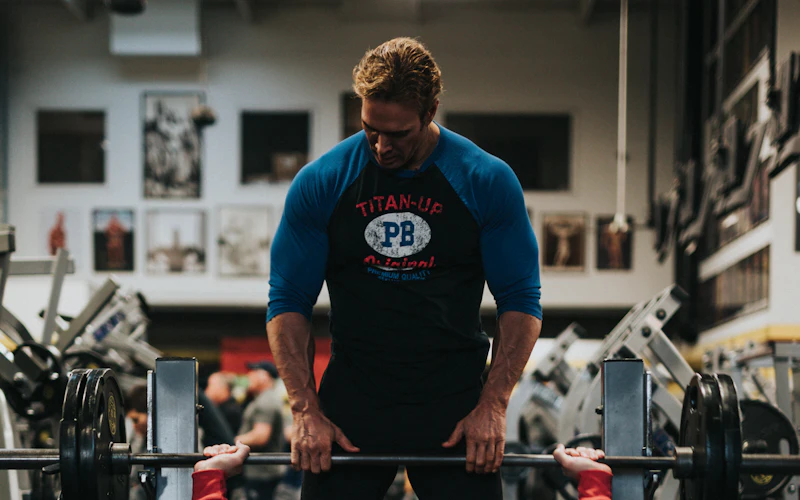
A beginner gym program has three sessions a week, two different workouts you alternate between, 8 to 10 reps a set and 2 to 3 sets per exercise. Add weight only when every set reaches the top of the rep range. Training all major muscle groups at least twice a week meets the guideline 1.
On this page
How the program works
Three sessions a week, for example Monday, Wednesday and Friday, and two different workouts, A and B, that you alternate. Week 1 is A, B, A. Week 2 is B, A, B. Both train the whole body, so every muscle group gets trained 2 to 3 times a week. That meets the guideline of at least two days a week for all major muscle groups 1, and a meta-analysis found that training a muscle twice a week gave more growth than once 2. If you only have room for two sessions, do A and B; that still meets the guideline minimum. See also the 2-day full body program.
It suits you if you have never trained, or have not for a while. If you want more variety later, look at the 3-day full body program or push pull legs. First time in a gym? Read first time at the gym first.
Workout A and workout B
Start each session with 5 minutes of easy movement and a few light sets of the first exercise. Then do the working sets.
| Workout | Exercise | Sets x reps | Rest |
|---|---|---|---|
| A | Leg press | 3 x 8 to 10 | 2 min |
| A | Dumbbell bench press | 3 x 8 to 10 | 2 min |
| A | Seated cable row | 3 x 8 to 10 | 2 min |
| A | Dumbbell shoulder press | 2 x 10 | 90 sec |
| A | Plank | 2 x 30 sec | 60 sec |
| B | Goblet squat | 3 x 8 to 10 | 2 min |
| B | Wide-grip lat pulldown | 3 x 8 to 10 | 2 min |
| B | Dumbbell Romanian deadlift | 3 x 8 to 10 | 2 min |
| B | Incline push-up | 2 x 8 to 12 | 90 sec |
| B | Dead bug | 2 x 8 per side | 60 sec |
The machines and dumbbells are chosen because they are easy to learn. If you cannot find an exercise, swap in a similar one with the same movement pattern: leg press for goblet squat, or the other way around.
Weeks 1 to 12
What changes is the number of sets, the weight and how hard you go. You do not need to track more than that.
| Weeks | Sets per exercise | How hard |
|---|---|---|
| 1 and 2 | 2 | Easy. 4 reps left after the last set. Learn the movements |
| 3 to 6 | 3 | 3 reps left. Add weight when you reach the top of the reps |
| 7 to 10 | 3 | 2 to 3 reps left. The weights should now feel like work |
| 11 | 3 | Same as week 10, but choose weights you can manage |
| 12 | 2 | Easier week. Half the volume, a few more reps left |
After week 12 you can start again from week 3 with heavier weights, or move to a program with more days, such as push pull legs or the upper lower split.
How to adjust it:
- Miss a session: skip it and take the next in the order. Do not double up.
- Miss two weeks or more: restart at week 3 with lighter weights.
- Short on time: drop the last exercise or two of the day, not the first.
- A joint complains: swap that exercise for a similar one and see a doctor or physiotherapist if the pain persists. The guide on knee-friendly leg exercises has options.
Picking weight and adding more
Start light, with a weight where you can do 10 reps and have 3 to 4 left. Nothing should feel hard in week 1. Then you learn what the exercise looks like and how the machine is set up. You do not have to go to failure to build muscle: sets stopped short of failure gave similar growth as sets to failure when volume was equal 3.
Add weight with double progression: stay within 8 to 10 reps. When every set reaches 10 reps in two sessions in a row, add the smallest step next time and start again at 8. Steps are small: 2.5 kg on a barbell, a few kilos on a cable stack or machine, one dumbbell size up. If a lift stands still for 3 weeks, keep going until it moves again.
Rest between sets
Rest 2 minutes on the big exercises and 60 to 90 seconds on the small ones. In a review of 23 studies, 60 to 120 seconds was enough for untrained people, while long rests over 2 minutes seemed to be needed to maximise strength in trained lifters 4.
If you get sore
It happens, especially in the first weeks. Soreness follows unfamiliar movements, peaks 24 to 72 hours after the session and is gone within 5 to 7 days 5. You do not need to wait until it is gone: easy movement and a walk are fine. Sharp pain in a joint, or pain that is not a tired muscle, is a reason to stop the session. If it lasts, see a doctor or physiotherapist.
How you know it works
Check three things after 4 weeks. You can lift more weight or do more reps on the same exercises than in week 1. The sessions feel shorter because you know the moves. And you have made all three sessions most weeks. The last one matters most.
How Amble does it
Amble writes your program case by case, in any weekly layout, from the days, the minutes and the kit you have, with a video for every exercise. The coach proposes changes, for example a gentler swap when something hurts, and nothing changes until you confirm. The app is not out yet; you can join the waitlist.
Questions
How many days a week should a beginner go to the gym?
Two or three. The WHO asks adults to do muscle-strengthening activity for all major muscle groups on at least two days a week 6. Three sessions leave more room to learn the movements, but only if you can keep them up in a bad week.
How long does a session take?
About 45 to 55 minutes with the warm-up. The first weeks go faster once someone has shown you the machines.
How much should I lift?
Pick a weight where you can do 10 reps with 3 to 4 left. You do not go to your limit. Sets stopped short of failure gave similar muscle growth in a meta-analysis 3.
How long should I rest between sets?
Two minutes on the big exercises and one minute on the small ones. A review found that 60 to 120 seconds seemed enough for untrained people 4.
Will I get sore?
Probably, especially at the start. Soreness follows unfamiliar movements, peaks 24 to 72 hours after the session and fades within 5 to 7 days 5. It is not a measure of how good the session was.
Sources
- American College of Sports Medicine. Resistance Training Prescription for Muscle Function, Hypertrophy, and Physical Performance in Healthy Adults: An Overview of Reviews. Medicine and Science in Sports and Exercise, 2026. acsm.org/resistance-training-guidelines-update-2026
- Schoenfeld BJ, Ogborn D, Krieger JW. Effects of Resistance Training Frequency on Measures of Muscle Hypertrophy: A Systematic Review and Meta-Analysis. Sports Medicine, 2016;46(11):1689-1697. doi:10.1007/s40279-016-0543-8 · PubMed
- Refalo MC, Helms ER, Trexler ET, Hamilton DL, Fyfe JJ. Influence of Resistance Training Proximity-to-Failure on Skeletal Muscle Hypertrophy: A Systematic Review with Meta-analysis. Sports Medicine, 2023;53(3):649-665. doi:10.1007/s40279-022-01784-y · PubMed
- Grgic J, Schoenfeld BJ, Skrepnik M, Davies TB, Mikulic P. Effects of Rest Interval Duration in Resistance Training on Measures of Muscular Strength: A Systematic Review. Sports Medicine, 2018;48(1):137-151. doi:10.1007/s40279-017-0788-x · PubMed
- Cheung K, Hume PA, Maxwell L. Delayed Onset Muscle Soreness. Sports Medicine, 2003;33(2):145-164. doi:10.2165/00007256-200333020-00005 · PubMed
- Bull FC, Al-Ansari SS, Biddle S, Borodulin K, Buman MP, Cardon G et al.. World Health Organization 2020 guidelines on physical activity and sedentary behaviour. British Journal of Sports Medicine, 2020;54(24):1451-1462. doi:10.1136/bjsports-2020-102955 · PubMed