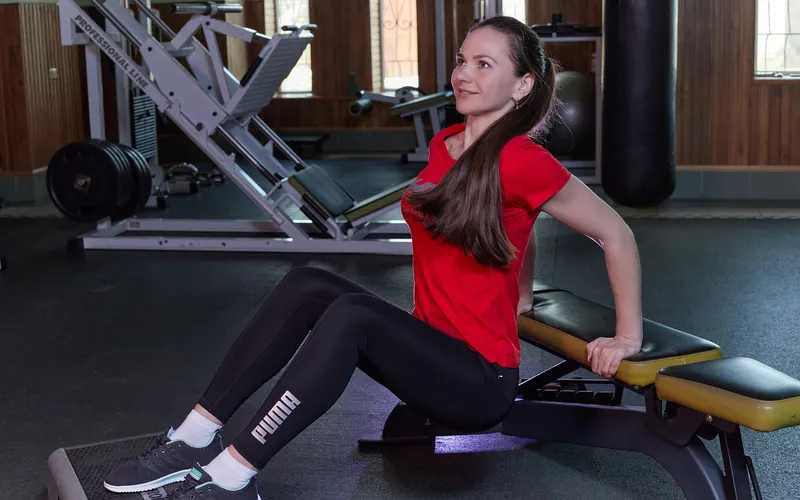
On day one, keep it short and simple: a 5-minute warm-up, then five machines for 2 sets of 10 at a light weight, and go home. Machines are easy to learn and give similar results to free weights for most people. Most of the nerves are gone by the third visit.
On this page
Before you go
Bring:
- Comfortable clothes you can move in and trainers with a flat, firm sole.
- A water bottle.
- A small towel. Most gyms expect you to wipe down machines after use, and many provide spray.
- Your plan, written down or on your phone. Walking in without one is the main reason first visits feel aimless.
- A padlock, if the gym has lockers without locks.
Go at a quiet time if you can. Mid-morning and early afternoon on weekdays are often calm. Monday evenings and January are not.
The visit, minute by minute
Minutes 0 to 5: arrive and find your way. Check in, find the changing room, find the water. Walk once around the floor. Machines usually sit together in one area, free weights in another, cardio machines in rows.
Minutes 5 to 10: warm up. Five minutes on a bike or walking on a treadmill at a pace where you can still talk. You want to feel a bit warm, not tired.
Minutes 10 to 40: five machines, 2 sets each. Do them in this order:
- Leg press. Legs and glutes.
- Machine chest press. Chest, shoulders, triceps.
- Seated cable row. Upper back.
- Lat pulldown. Back and arms.
- Seated leg curl. Back of the thighs.
For each one: set the seat so the handles or pads line up with the picture on the machine, pick a light weight, and do 10 slow reps. Rest a minute or two. Do 10 more. On day one the weight should feel easy. You are learning the setup.
Minutes 40 to 45: plank and finish. Two planks of 15 to 20 seconds on a mat. Write down the weight and seat setting for each machine. Wipe down what you used. Go home.
That is the whole first session. It is meant to feel unfinished. Leaving with energy left makes the second visit easier to face.
Why machines first
Machines guide the path of the movement, so there is less to think about. They let you change weight in small steps by moving a pin. And if a rep goes wrong, you can let go or stop safely.
You are not missing out by starting there. The ACSM's 2026 position stand, which pooled 137 systematic reviews, found that machines versus free weights did not consistently change outcomes for average healthy adults 1. Free weights are worth learning later because they carry over to lifting things at home. They are not required.
Reading a machine
Most machines have a diagram on the side. Look for three things:
- The seat or pad adjustment. Usually a pin or lever. Set it so the joint that moves (knee, elbow, shoulder) lines up with the machine's pivot point, often marked with a coloured dot.
- The weight stack. A column of plates with a pin. Each plate has a number. Start near the top of the stack, where it is lightest.
- The start position. The picture shows where your body should be at the start.
If something feels wrong at the joint, adjust the seat before you change the weight.
Unwritten rules
- Wipe down benches and handles when you finish.
- Put dumbbells and plates back where they came from.
- Do not sit on a machine scrolling your phone between sets when it is busy. Rest standing nearby, or let someone work in.
- It is fine to ask someone "how many sets do you have left?"
- Headphones in usually means "I'd rather not chat". It does not mean you cannot ask a quick question.
- Nobody is watching you as closely as you think. Almost everyone is thinking about their own set.
What to expect afterwards
You will probably feel fine that evening and be stiff a day or two later, especially in your thighs. That is normal soreness after unfamiliar exercise, and it fades within a few days. Muscle soreness after training explains when it is not normal.
Your second and third visits
Come back within three or four days. Same five machines. This time, aim for a weight where the last couple of reps take some effort, with 3 or so left in the tank. How heavy should you lift explains how to judge it.
By the third visit you will know where things are, how to set the machines and roughly what weight to use. That is when the full plan in how to start strength training starts to make sense. If the gym still does not feel right after a few weeks, gym or home compares the options.
Amble has a short video for most exercises, so you can check the setup on your phone at the machine before your first set.
Questions
What if every machine is busy?
Ask someone if you can work in between their sets, or do the next exercise on your list and come back. The order is less important than doing them all.
Should I book a session with a trainer?
If the gym offers a free introduction, take it. Ask them to show you how to set up the five machines on your list.
Sources
- American College of Sports Medicine. Resistance Training Prescription for Muscle Function, Hypertrophy, and Physical Performance in Healthy Adults: An Overview of Reviews. Medicine and Science in Sports and Exercise, 2026. acsm.org/resistance-training-guidelines-update-2026